
Klow Peptide Dosage: Complete Protocol Guide for Safe, Optimal Results
Klow peptide dosage ranges from 250–750 mcg daily via subcutaneous injection in educational protocols, though some sources recommend 2.7–5.3 mg (2,700–5,300 mcg) daily with gradual titration. Reconstitute 80mg vial with 3.0 mL bacteriostatic water for ~26.7 mg/mL concentration, where 10 units (0.10 mL) equals ~267 mcg total peptides on a U-100 insulin syringe.
Why Search “Klow Peptide Dosage” Carefully?
 You’re probably searching klow peptide dosage because you need the correct dosing protocol for this four-peptide research blend but found conflicting information online. Maybe you’re conducting tissue repair studies, inflammatory pathway research, or need cellular regeneration compounds for in-vitro experiments. The mistake many make is confusing dosage ranges—some sources recommend 250–750 mcg daily while others suggest 2.7–5.3 mg (2,700–5,300 mcg) daily. The difference depends on reconstitution volume and whether you’re using the standard 80mg vial vs. smaller quantities. I’ve reviewed multiple dosage protocols, reconstitution guides, and titration schedules, and I’ll share exactly how to calculate the correct dose, what weekly titration looks like, and critical storage requirements.
Important Note: KLOW peptide is FOR RESEARCH USE ONLY – NOT FOR HUMAN USE. This is educational information for qualified research professionals conducting laboratory studies only.
What You Need to Know Before Determining Klow Peptide Dosage
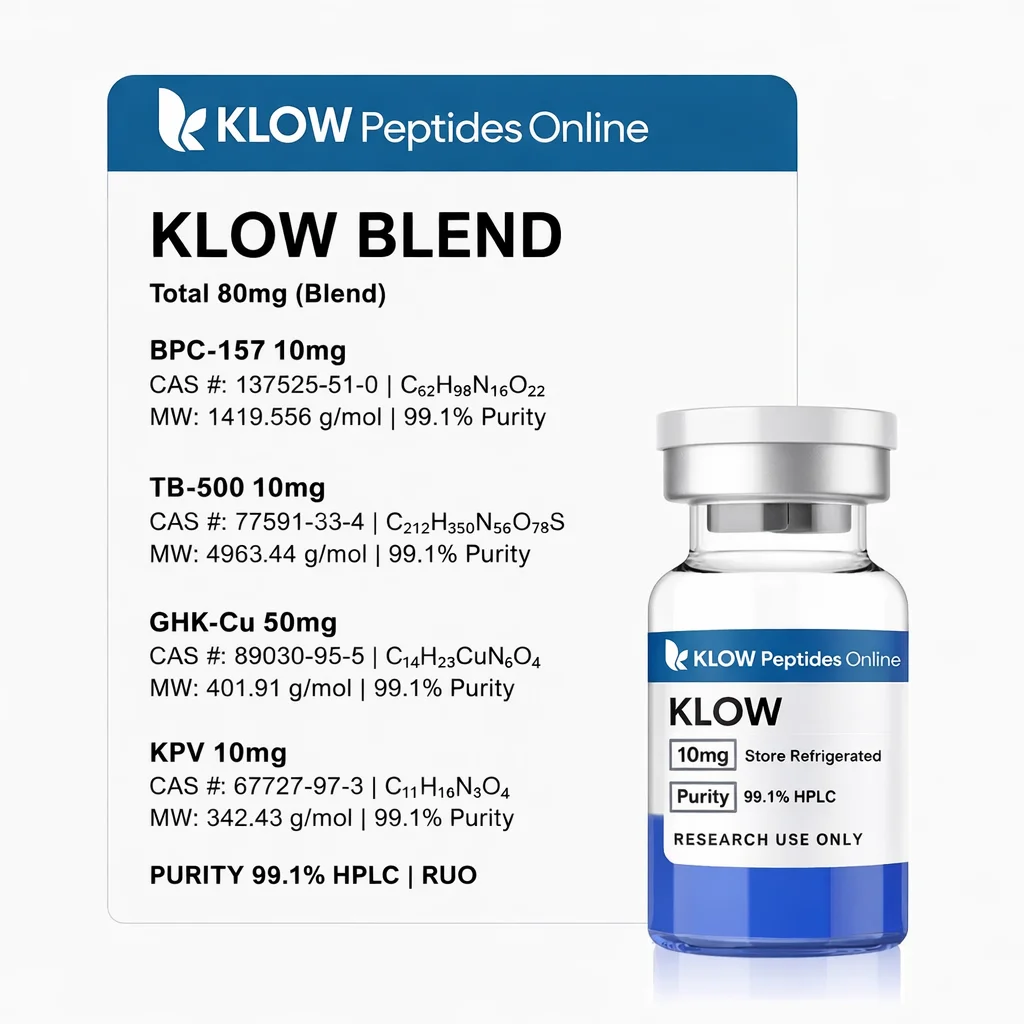
Klow peptide (also called KLOW Blend 80mg) contains four specific research peptides:
-
GHK-Cu (50 mg): Collagen synthesis and cellular rejuvenation
-
BPC-157 (10 mg): Tissue repair and angiogenic studies
-
TB-500 (10 mg): Cellular recovery and systemic regeneration
-
KPV (10 mg): Inflammatory-pathway research
Total: 80mg per vial with ≥99% purity.
Research Use Only: KLOW is intended exclusively for in vitro laboratory research by qualified professionals, NOT FOR HUMAN OR VETERINARY CONSUMPTION.
Quick Dosage Overview
Two Common Klow Peptide Dosage Protocols
Protocol 1: Conservative Approach (250–750 mcg Daily)
Used by: PeptideDosages.com
Reconstitution:
-
Add 1.0 mL bacteriostatic water to 80mg vial
-
Concentration: ~26.7 mg/mL (26,700 mcg/mL)
-
1 unit (0.01 mL) ≈ 267 mcg total peptides
Dosage Schedule:
Frequency: Once daily subcutaneous injection
Best for: Beginners, first-time users, sensitivity testing
Protocol 2: Standard Gradual Approach (2.7–5.3 mg Daily)
Used by: PeptideDosages.com, DosagePeptide.com
Reconstitution:
-
Add 3.0 mL bacteriostatic water (max vial capacity) to 80mg vial
-
Concentration: ~26.7 mg/mL (26,700 mcg/mL)
-
1 unit (0.01 mL) ≈ 267 mcg total peptides
Dosage Schedule (Gradual Titration):
Frequency: Once daily subcutaneous injection
Titration schedule: Start at 10 units (~2.7 mg); increase by ~5 units (~1.3 mg) every 2–4 weeks
Best for: Standard research protocols, tissue repair studies
Klow Peptide Dosage Chart: Week-by-Week Breakdown
Conservative Protocol (250–750 mcg)
Standard Protocol (2.7–5.3 mg)
Note: If any dose falls below ~10 units, consider using 30- or 50-unit insulin syringes for finer gradations.
How to Reconstitute Klow Peptide for Accurate Dosage
Step-by-Step Reconstitution Guide
For 80mg Vial (Standard Protocol):
-
Prepare materials:
-
80mg KLOW lyophilized vial
-
3.0 mL bacteriostatic water
-
U-100 insulin syringe (1mL, 29–31 gauge)
-
Alcohol swabs
-
-
Add bacteriostatic water:
-
Inject 3.0 mL bacteriostatic water slowly into vial
-
Max vial capacity: 3.0 mL
-
-
Calculate concentration:
-
80mg ÷ 3.0 mL = ~26.7 mg/mL (26,700 mcg/mL)
-
1 unit (0.01 mL) = ~267 mcg total peptides
-
-
Gentle mixing:
-
Swirl gently until fully dissolved
-
Avoid vigorous shaking (can damage peptide structure)
-
-
Storage after reconstitution:
-
Refrigerate at 2–8°C (36–46°F)
-
Use within 28 days
-
Avoid repeated freeze-thaw cycles
-
Alternative: 1 mL Reconstitution (Conservative Protocol)
-
Add 1.0 mL bacteriostatic water
-
Concentration: ~80 mg/mL (80,000 mcg/mL)
-
1 unit = ~800 mcg (requires more precise syringe)
Klow Peptide Dosage: Injection Frequency & Timing
Frequency
-
Inject once daily subcutaneously
-
Consistent schedule: Same time each day
-
Rotate injection sites: Abdomen, deltoid, thigh
Timing
-
Best time: Morning before training (supports tissue repair)
-
Alternative: Post-workout (supports recovery)
-
Consistency matters: More important than specific time
Cycle Length
-
Standard: 8–12 weeks
-
Optional extension: 16 weeks if desired
-
Break period: 2–4 weeks after cycle completion
Klow Peptide Dosage: What to Expect by Week
Week 1–2 (Starting Dose: 10 units / 2.7 mg)
-
Goal: Assess tolerance and sensitivity
-
Expected: Minimal visible changes
-
Purpose: Baseline for titration
Week 3–6 (Mid Dose: 15 units / 4 mg)
-
Goal: Support tissue repair and inflammation reduction
-
Expected: Noticeable improvements in energy, mobility, recovery speed
-
Duration: 4 weeks at this dose
Week 7–12 (Target Dose: 20 units / 5.3 mg)
-
Goal: Maximize tissue regeneration and anti-inflammatory effects
-
Expected: Improved skin texture, enhanced recovery, reduced inflammation
-
Duration: 6 weeks at this dose
Results vary based on dosage, lifestyle, diet, protein intake, and individual response.
Klow Peptide Dosage: Storage & Stability Requirements
Before Reconstitution
-
Store at: -20°C frozen
-
Environment: Dry, away from light and moisture
-
Shelf life: 1–2 years (check manufacturer specifications)
After Reconstitution
-
Store at: 2–8°C (36–46°F) refrigerated
-
Duration: Up to 28 days
-
Protection: Avoid repeated freeze-thaw cycles
-
Sign of degradation: Cloudiness, discoloration, precipitate
During Use
-
Keep refrigerated between injections
-
Remove briefly only for injection (30 seconds max outside fridge)
-
Protect from: Direct sunlight, temperature fluctuations
Klow Peptide Dosage: Common Mistakes to Avoid
Mistake 1: Using Wrong Reconstitution Volume
Wrong: Adding 1 mL when protocol recommends 3 mL (makes dose 3x higher).
Right: Follow protocol exactly—3.0 mL for standard protocol, 1.0 mL for conservative.
Mistake 2: Not Calculating Units Correctly
Wrong: Assuming 10 units = 1 mg (incorrect at 26.7 mg/mL).
Right: At 26.7 mg/mL, 10 units (0.10 mL) = ~267 mcg (0.267 mg).
Mistake 3: Skipping Titration Steps
Wrong: Starting at 20 units without gradual increase.
Right: Increase by ~5 units (~1.3 mg) every 2–4 weeks.
Mistake 4: Inconsistent Injection Timing
Wrong: Injecting at random times each day.
Right: Same time daily for consistent peptide levels.
Mistake 5: Over-reconstituted Vials
Wrong: Adding more than 3.0 mL (exceeds max vial capacity).
Right: Maximum 3.0 mL bacteriostatic water per 80mg vial.
Klow Peptide Dosage: Safety Considerations
Start Low, Go Slow
-
Begin with 10 units (~2.7 mg) for Weeks 1–2
-
Increase gradually by 5 units every 2–4 weeks
-
Monitor for: Injection-site reactions, mild fatigue, warmth
Injection-Site Reactions
-
Common: Small redness, itching with subcutaneous dosing
-
Less common: Mild warmth or temporary fatigue after injection
-
Management: Rotate injection sites, inject slowly over 30 seconds
Important Research Use Warning
-
NOT FOR HUMAN USE: KLOW is exclusively for laboratory research
-
Not FDA-approved: Has not been evaluated for medical use
-
Qualified professionals only: Handling performed by research professionals following safety protocols
Frequently Asked Questions
What is the recommended klow peptide dosage?
The recommended klow peptide dosage ranges from 250–750 mcg daily (conservative) or 2,700–5,300 mcg (2.7–5.3 mg) daily (standard) via once-daily subcutaneous injection.
How do I calculate klow peptide dosage units?
At 26.7 mg/mL concentration (80mg reconstituted with 3.0 mL water):
-
1 unit (0.01 mL) = ~267 mcg total peptides
-
10 units (0.10 mL) = ~2,667 mcg (2.7 mg)
-
15 units (0.15 mL) = ~4,000 mcg (4 mg)
-
20 units (0.20 mL) = ~5,333 mcg (5.3 mg)
How long should I cycle klow peptide?
Standard cycle length is 8–12 weeks, with optional extension to 16 weeks. Follow with 2–4 week break before next cycle.
Can I increase klow peptide dosage faster?
No. Increase by ~5 units (~1.3 mg) every 2–4 weeks gradually. Faster titration risks reduced tolerance or adverse reactions.
What syringe should I use for klow peptide dosage?
Use U-100 insulin syringe (1mL, 29–31 gauge). If doses fall below 10 units, consider 30- or 50-unit syringes for finer gradations.
How should I store klow peptide after reconstitution?
Refrigerate at 2–8°C (36–46°F) for up to 28 days. Avoid repeated freeze-thaw cycles and protect from light.
Is klow peptide dosage the same for everyone?
No. Dosage varies based on research goals, body weight, sensitivity, and protocol type (conservative vs. standard). Always start low and titrate gradually.
What’s the difference between conservative and standard klow dosage?
Conservative: 250–750 mcg daily (1–3 units)
Standard: 2,700–5,300 mcg daily (10–20 units). Standard is ~10x higher, used for tissue repair studies.
Final Thoughts: Klow Peptide Dosage for Research Success
The correct klow peptide dosage depends on your protocol type. For beginners, start conservative at 250 mcg daily (1 unit). For standard tissue repair research, use 2.7 mg daily (10 units) and gradually increase to 5.3 mg daily (20 units) over 12 weeks.
Reconstitute with 3.0 mL bacteriostatic water for 26.7 mg/mL concentration where 10 units = ~267 mcg. Inject once daily subcutaneously for 8–12 weeks, then take 2–4 week break.
Critical reminder: KLOW is FOR RESEARCH USE ONLY – NOT FOR HUMAN USE. This protocol is educational information for qualified research professionals conducting in-vitro laboratory studies only.
For dosage calculators and protocols, check klow peptide dosage chart or klow peptide protocol.
Reviews
There are no reviews yet.